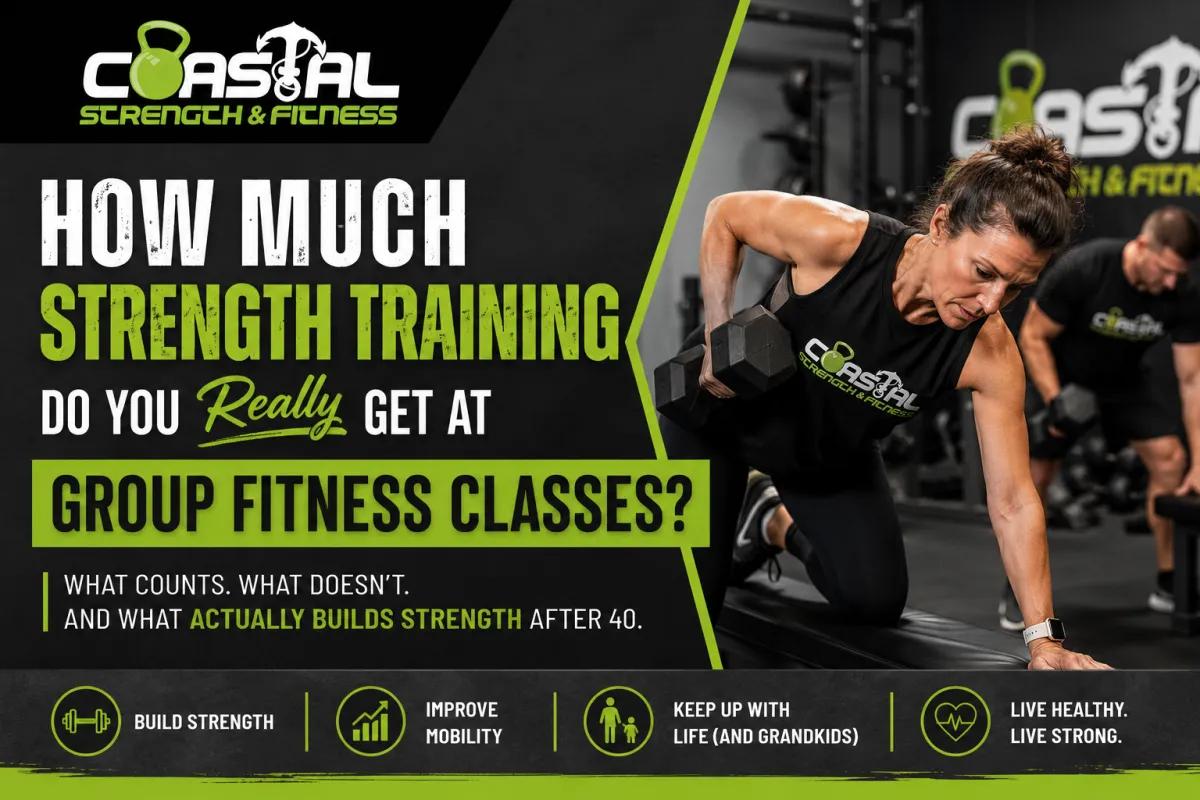
How Much Strength Training Do You Really Get at Group Fitness Classes?
You show up consistently.
You sweat.
Your heart rate is through the roof.
Maybe your watch says you burned 500 calories.
But here is a question almost nobody asks:
Are you actually getting meaningful strength training?
Because the answer matters more than most people realize—especially after age 40.
At Coastal Strength & Fitness in Newport News, we see this all the time. Someone joins after doing another group fitness program for years. They have worked hard. They are consistent. They genuinely care about their health.
But once we start strength training?
They quickly realize something:
They have been doing a lot of movement… but not a lot of true resistance training.
And there is a difference.
Before anyone gets defensive, let’s be fair:
Many group fitness classes are great for cardiovascular health, burning calories, building consistency, and simply helping people move more. That matters. A lot.
Movement is almost always better than doing nothing.
But if your goal is to build strength, maintain muscle, improve bone density, age well, and stay capable as life demands more from you?
You need to understand what actually counts as strength training.
When “Strength Training” Becomes Cardio With Weights
Here is the uncomfortable truth:
Many group fitness classes provide very little true strength training stimulus.
Even when dumbbells are involved.
Why?
Because the format often works against it.
Think about a typical setup:
Little to no rest between exercises
Fast transitions
Constant movement encouraged
Limited equipment options
Everyone using similar weights
Focus on feeling tired, sweaty, or “worked”
The problem?
At a certain point, what feels like strength training starts functioning more like cardio.
That is not automatically bad.
But it is different.
If you are grabbing a weight you could easily do for 35, 40, or 50 reps… then rushing immediately to another exercise with almost no rest?
You are likely training your cardiovascular system far more than your muscular system.
Again: useful? Sure.
Optimal for building muscle, strength, and bone density? Probably not.
What Actually Creates Strength and Muscle?
Your body adapts to the signals you send it.
If you want stronger muscles and bones, better function, and more resilience as you age, the body needs a clear reason to change.
That generally means:
1. Using enough resistance
The weight needs to be challenging.
A good rule of thumb?
You should finish most working sets feeling like you had roughly 1–4 good reps left in the tank.
Exercise science people call this “reps in reserve.”
In plain English:
You should not be failing every set.
But it also should not feel easy.
There is a sweet spot.
2. Working in productive rep ranges
You can build strength and muscle across a fairly wide range, but generally speaking:
Somewhere between 5–30 reps can work very well—if the set is challenging enough.
The issue in many classes is not the rep count.
It is that the resistance is often too light to create enough stimulus.
3. Resting enough between sets
This one surprises people.
Rest matters.
A lot.
If your heart rate is still sky high and you are breathing hard when you start your next set, your muscles may not be ready to give a high-quality effort again.
For strength-focused training, you often want enough recovery to bring your breathing and heart rate back down so you can perform another strong set with good form.
This is one reason many people feel strange when they first join us.
They think:
“Wait… we are allowed to rest?”
Yes.
Because the goal matters.
On cardio days? Different story.
On strength days? We want focus, quality, and enough recovery to train hard.
4. Progressive overload
One of the biggest predictors of results?
Tracking progress.
If you are doing the exact same weights year after year, your body has very little reason to adapt.
You should gradually be improving.
More reps.
Better form.
A little more resistance.
More control.
At Coastal, we repeat key lifts week to week for a reason.
You cannot improve what you never repeat.
The Hidden Problem With Many Group Fitness Models
Here is something most people never think about:
Equipment matters.
Especially for adults over 40.
One of the biggest limitations we see in group fitness programs?
Not enough pulling exercises.
Many places have limited options if someone cannot do chin-ups or pull-ups.
Maybe there are dumbbell rows.
But what happens when the available weights stop at 20 or 30 pounds?
Or when the jump to the next weight is too large?
Progress stalls.
At Coastal Strength & Fitness, we invested heavily in having dumbbells up to 100 pounds and cable systems for rows, pulldowns, and their variations because small progressions matter.
Especially for beginners.
Especially for women.
Especially for adults over 40 who want to build confidence while staying safe.
“But I’m Sore… Doesn’t That Mean It Worked?”
Not necessarily.
This is one of the biggest myths in fitness.
Soreness does not equal effectiveness.
Sometimes soreness simply means novelty.
Your body experienced something unfamiliar.
Sometimes it means you did too much.
And if you are always extremely sore?
That may actually be a sign your program is making recovery harder than it needs to be.
Productive training should help you improve—not crush you every session.
Many of our best long-term clients leave workouts feeling challenged but still capable of living normal life afterward.
Because consistency beats intensity you cannot sustain.
“I Just Want to Tone”
This one comes up all the time.
Here is the honest truth:
“Toning” is mostly building or maintaining muscle while reducing body fat.
That is it.
You do not “tone” a muscle with tiny weights and endless reps.
You create shape by building muscle and improving body composition.
Which means resistance training matters.
Especially as we age and naturally lose muscle mass.
“Lifting Heavy Sounds Dangerous”
First:
“Heavy” is relative.
For one person, heavy might mean a 10-pound dumbbell.
For another, it might mean 50 pounds.
The point is not ego.
The point is challenge.
And challenge should match your current ability.
Good coaching means helping someone find an appropriate level that feels safe, controlled, and productive.
Ironically, many adults over 40 become more resilient when they strength train properly.
We regularly hear things like:
“I can carry things easier.”
“I can get off the floor easier.”
“I have more confidence in my body.”
“I can keep up with my grandkids.”
“I feel more capable.”
That is what matters.
A Quick Checklist: Is Your Group Fitness Class Actually Strength Training?
Ask yourself:
✅ Am I using weights that feel meaningfully challenging?
✅ Am I resting enough to repeat quality effort?
✅ Am I progressing over time?
✅ Do we train all major movement patterns (push, pull, squat, hinge, carry, core)?
✅ Is form prioritized over speed?
✅ Can I gradually increase resistance in manageable increments?
If the answer is mostly “no,” your class may function more like cardio with weights.
Again—nothing wrong with cardio.
Cardio matters.
But if your goal is healthy aging, maintaining muscle, improving bone density, building confidence, and staying independent?
You probably need true resistance training too.
At Coastal Strength & Fitness in Newport News, we intentionally separate our strength days from our endurance days because the goal should be clear.
Some days are for building strength.
Some days are for conditioning.
Both matter.
But they are not the same thing.
And after 40?
Understanding the difference can change everything.
Thinking about whether your current workout is actually helping you build strength? We are always happy to help people figure that out—even if it just means pointing you in the right direction.


