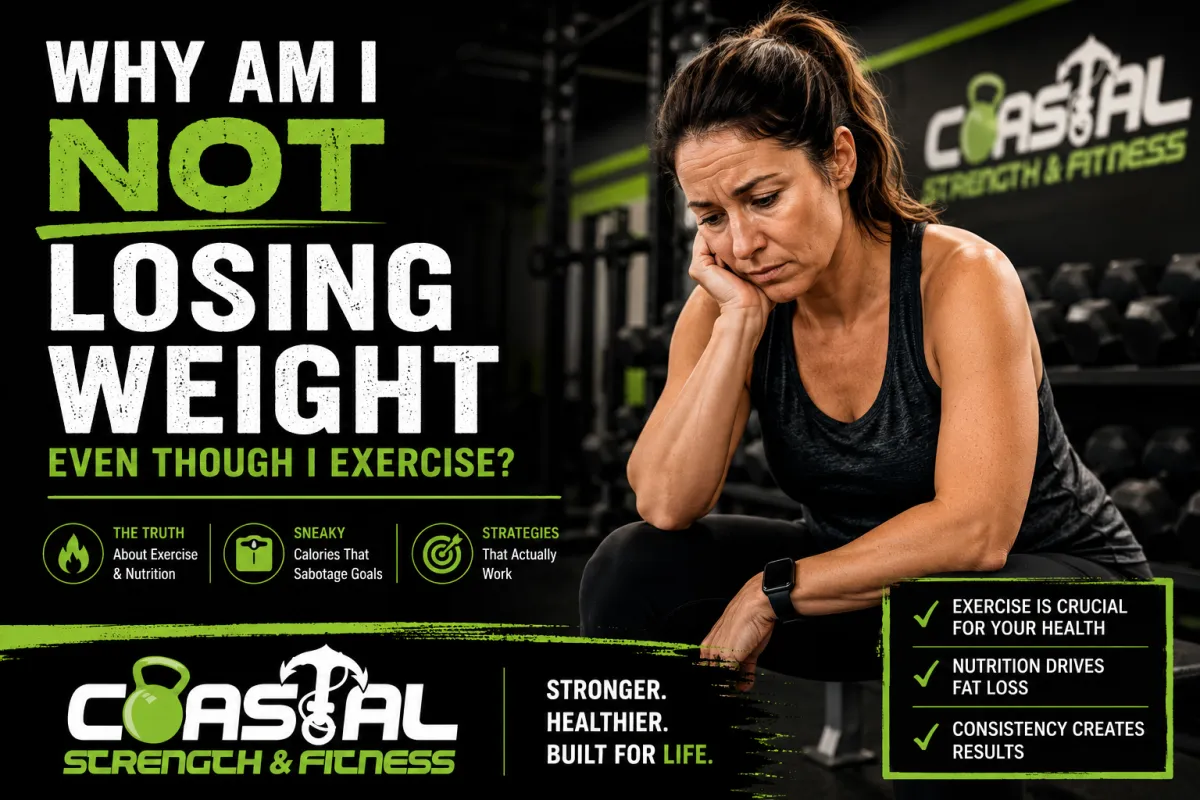
Why Am I Not Losing Weight Even Though I Exercise?
If you've been exercising consistently but the scale isn't moving, you're not alone.
It's one of the most common questions we hear at Coastal Strength & Fitness.
The good news is that it doesn't necessarily mean you're doing anything wrong.
The better news? Once you understand how weight loss actually works, you'll be able to focus your energy where it matters most instead of becoming frustrated and giving up.
Let's clear up one of the biggest misconceptions in fitness.
Exercise Isn't the Primary Driver of Weight Loss
This surprises many people.
Exercise absolutely burns calories. It also improves your heart health, builds muscle, strengthens your bones, improves blood sugar control, boosts your mood, and helps you stay independent as you age.
But exercise alone usually isn't enough to create meaningful weight loss.
Ultimately, fat loss comes down to creating a calorie deficit over time—you must consistently consume fewer calories than your body burns.
That doesn't make exercise unimportant.
It simply means exercise and nutrition have different jobs.
Nutrition creates the calorie deficit that leads to fat loss.
Exercise helps you preserve muscle, stay strong, improve your health, and make sure the weight you lose is primarily fat—not muscle.
When you understand that distinction, everything starts to make more sense.
Beware of "Sneaky Calories"
One phrase we use often with our members is "sneaky calories."
These are the calories that don't feel like much in the moment but quietly add up over the course of a day—or a weekend.
Some common examples include:
A few handfuls of chips while making dinner.
Grabbing a handful of nuts every time you walk through the kitchen.
Finishing your child's leftovers.
A specialty coffee on the way to work.
A couple of bites here and there while cooking.
None of these seem significant individually.
Together, however, they can easily add several hundred calories to your day.
What's surprising is that a mindless snacking session can contain more calories than a complete, balanced meal.
For example, a plate of grilled chicken, a baked potato, and broccoli may contain fewer calories than several handfuls of nuts and chips eaten absentmindedly over an evening.
Healthy foods can also become sneaky calories.
Nuts, peanut butter, avocado, olive oil, and granola are all nutritious foods—but they're also calorie-dense. Eating large portions of healthy foods can still prevent fat loss.
Restaurants Make Portion Control Even Harder
Restaurant nutrition information is helpful—but it's still an estimate.
A menu might assume one tablespoon of cooking oil.
The cook preparing your meal during a busy Friday night probably isn't measuring every tablespoon of oil or every pat of butter.
Their job is to prepare delicious food.
And let's be honest—fat tastes good.
This doesn't mean you should never eat out.
It simply means restaurant meals often contain more calories than we realize.
That's why we encourage people to think about their overall weekly habits, not just individual meals.
Stop Playing the "Calories Burned" Game
After almost every workout someone asks:
"How many calories did I burn?"
Our answer is always similar.
There isn't a truly accurate way to know.
Your smartwatch says one number.
The treadmill says another.
An online calculator gives you something different.
None of them are accurate enough to make nutrition decisions from.
More importantly, chasing calories burned often leads people to eat back more calories than they actually expended.
Instead of asking,
"How many calories did I burn?"
Ask yourself,
"Did I get stronger today? Did I improve my health today?"
Those are questions that matter much more in the long run.
Don't Reward Exercise With Food
One of the easiest traps to fall into is thinking:
"I worked out today, so I earned this."
There's nothing wrong with enjoying your favorite foods.
The problem comes when exercise becomes permission to consistently overeat.
A challenging workout may burn a few hundred calories.
You can consume that many calories in just a few minutes.
That's why trying to "earn" your food through exercise is a game that's very difficult to win.
Instead, exercise because you want to become stronger, healthier, and more capable.
Then let your nutrition determine whether you're in a calorie deficit.
Use the Scale Correctly
Some people become obsessed with the scale.
Others refuse to step on it.
We think the truth is somewhere in the middle.
The scale is an excellent tool—as long as you understand what it's measuring.
Your body weight includes:
Body fat
Muscle
Water
Glycogen
Food in your digestive system
Hydration status
A salty dinner, poor sleep, a hard workout, or simply drinking more water can cause your weight to fluctuate by several pounds from one day to the next.
That's why we recommend weighing yourself daily under similar conditions and calculating a weekly average.
Don't judge your progress based on today's number.
Look at the trend over several weeks.
That's where the real story is.
Track Strength While Losing Weight
The scale isn't the only measure of progress.
Neither is how your clothes fit.
One of the things we pay close attention to is strength.
If you're maintaining—or even improving—your strength while losing weight, that's an encouraging sign that you're preserving muscle.
That's important because muscle helps support your metabolism, improves your quality of life, and becomes increasingly valuable as we age.
Weight loss shouldn't simply be about becoming a smaller version of yourself.
It should be about becoming a healthier, stronger version of yourself.
Before You Eat Less, Audit Your Habits
If you're actively trying to lose fat and your weekly weight average hasn't changed for about two weeks, it may be time to make an adjustment.
But before immediately cutting more calories, ask yourself:
Am I accurately measuring portions?
Have restaurant meals become more frequent?
Have weekends looked very different than weekdays?
Have sneaky calories started creeping back in?
Am I honestly tracking what I'm eating?
More often than not, the issue isn't that your calorie target is too high.
It's that your actual intake has drifted above it without you realizing.
A quick audit is usually more effective than immediately eating less.
What Successful Clients Have in Common
The members who are most successful with weight loss rarely rely on motivation alone.
Instead, they build habits they can maintain.
They typically:
Weigh themselves consistently and focus on weekly averages.
Practice portion control without striving for perfection.
Set up their home food environment for success.
Keep nutritious foods readily available.
Stay consistent even after weekends, vacations, or holidays.
Continue strength training throughout the process.
They understand that lasting results come from repeating good habits—not finding the perfect diet.
Don't Let the Scale Decide Whether Exercise Is Worth It
This may be the most important point in this entire article.
If the only reason you exercise is to lose weight, what happens when the scale stalls?
Many people decide it's not working and quit.
That would be a mistake.
Every workout is still helping you:
Preserve muscle.
Improve cardiovascular health.
Build stronger bones.
Improve blood sugar control.
Lower your risk of chronic disease.
Increase energy.
Improve mood.
Stay active and independent as you get older.
Those benefits don't disappear simply because the scale didn't change this week.
The scale is one measurement of progress.
It is not the only one.
The Bottom Line
If you're exercising consistently but not losing weight, the answer usually isn't that exercise has failed.
More often, it's that nutrition needs more attention than exercise can overcome.
That's why one of the most common sayings in fitness has stood the test of time:
You can't out-exercise a poor diet.
But there's another message that's just as important:
Don't stop exercising because the scale isn't moving.
Exercise and nutrition work together—but they have different jobs.
Nutrition helps create the calorie deficit needed for fat loss.
Exercise helps ensure you become stronger, healthier, and more resilient while you lose it.
If you're looking for a structured, supportive program that combines strength training, coaching, and accountability to help you build healthy habits for the long term, we'd love to help.
At Coastal Strength & Fitness in Newport News, VA, we help adults—especially those over 40—become stronger, healthier, and more confident through smart, evidence-based training that fits real life.


